pacman::p_load(ggtern, plotly, tidyverse)Hands-on Exercise 5: Ternary Plot
1. Plotting Ternary Diagram with R
Install and launching R packages.
The code chunk below uses p_load() of pacman package to check if packages are installed in the computer. If they are, then they will be launched into R. The R packages installed are:
- ggtern, a ggplot extension specially designed to plot ternary diagrams. The package will be used to plot static ternary plots.
- Plotly R, an R package for creating interactive web-based graphs via plotly’s JavaScript graphing library, plotly.js . The plotly R libary contains the ggplotly function, which will convert ggplot2 figures into a Plotly object.
Importing the data
pop_data <- read_csv("data/respopagsex2000to2018_tidy.csv") Preparing the data
agpop_mutated <- pop_data %>%
  mutate(`Year` = as.character(Year))%>%
  spread(AG, Population) %>%
  mutate(YOUNG = rowSums(.[4:8]))%>%
  mutate(ACTIVE = rowSums(.[9:16]))  %>%
  mutate(OLD = rowSums(.[17:21])) %>%
  mutate(TOTAL = rowSums(.[22:24])) %>%
  filter(Year == 2018)%>%
  filter(TOTAL > 0)

agpop_mutated
# A tibble: 234 × 25
PA SZ Year AGE0-…¹ AGE05…² AGE10…³ AGE15…⁴ AGE20…⁵ AGE25…⁶ AGE30…⁷
<chr> <chr> <chr> <dbl> <dbl> <dbl> <dbl> <dbl> <dbl> <dbl>
1 Ang Mo K… Ang … 2018 180 270 320 300 260 300 270
2 Ang Mo K… Chen… 2018 1060 1080 1080 1260 1400 1880 1940
3 Ang Mo K… Chon… 2018 900 900 1030 1220 1380 1760 1830
4 Ang Mo K… Kebu… 2018 720 850 1010 1120 1230 1460 1330
5 Ang Mo K… Semb… 2018 220 310 380 500 550 500 300
6 Ang Mo K… Shan… 2018 550 630 670 780 950 1080 990
7 Ang Mo K… Tago… 2018 260 340 430 500 640 690 440
8 Ang Mo K… Town… 2018 830 930 930 860 1020 1400 1350
9 Ang Mo K… Yio … 2018 160 160 220 260 350 340 230
10 Ang Mo K… Yio … 2018 810 1070 1300 1450 1500 1590 1390
# … with 224 more rows, 15 more variables: `AGE35-39` <dbl>, `AGE40-44` <dbl>,
# `AGE45-49` <dbl>, `AGE50-54` <dbl>, `AGE55-59` <dbl>, `AGE60-64` <dbl>,
# `AGE65-69` <dbl>, `AGE70-74` <dbl>, `AGE75-79` <dbl>, `AGE80-84` <dbl>,
# AGE85over <dbl>, YOUNG <dbl>, ACTIVE <dbl>, OLD <dbl>, TOTAL <dbl>, and
# abbreviated variable names ¹`AGE0-4`, ²`AGE05-9`, ³`AGE10-14`, ⁴`AGE15-19`,
# ⁵`AGE20-24`, ⁶`AGE25-29`, ⁷`AGE30-34`Static Ternary Diagram
ggtern(data = agpop_mutated,
       aes(x = YOUNG,
           y = ACTIVE,
           z = OLD)) +
  geom_point() +
  labs(title = "Population structure, 2015") +
  theme_rgbw()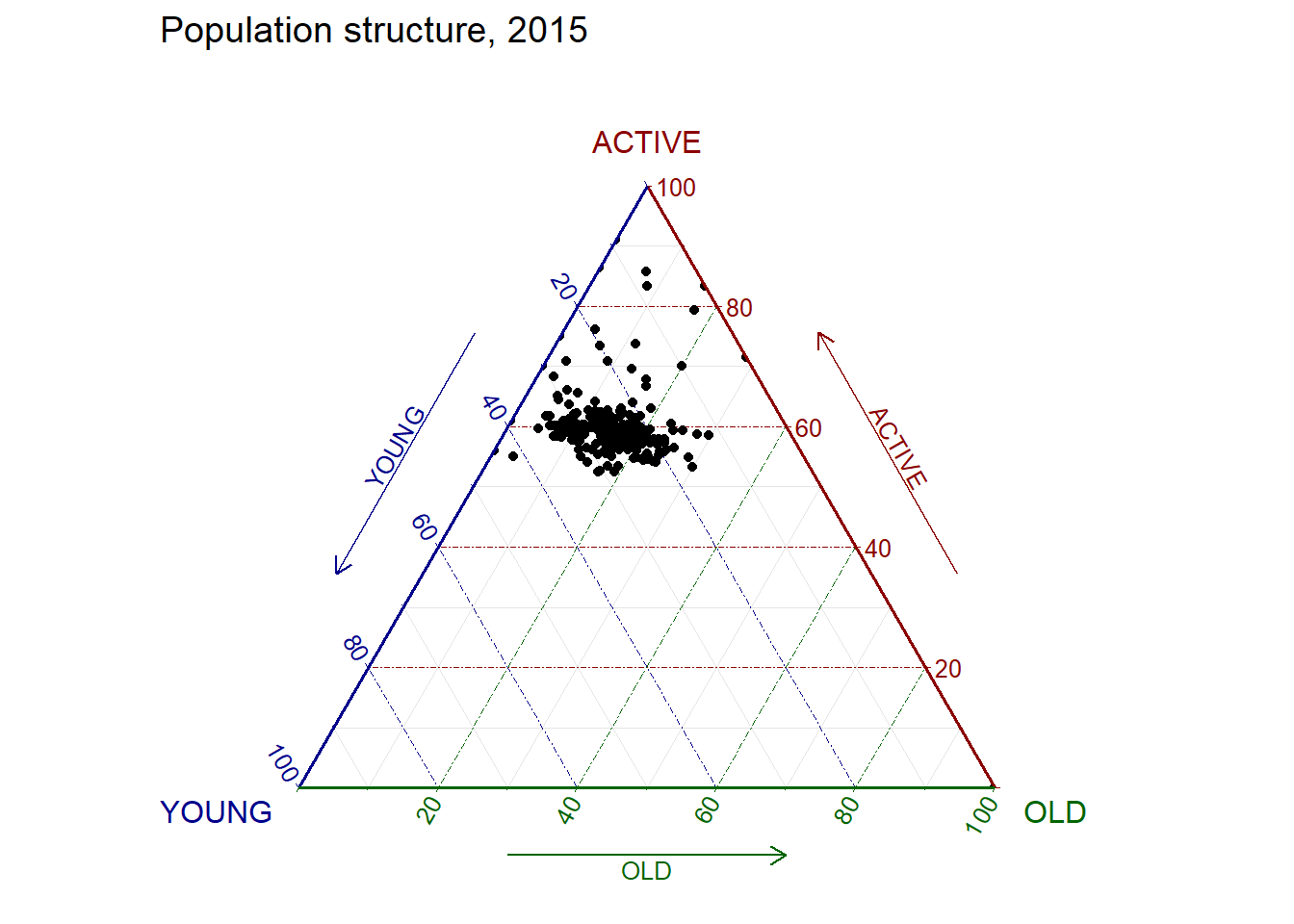
Interactive Ternary Diagram
label <- function(txt) {
  list(
    text = txt,
    x = 0.1, y = 1,
    ax = 0, ay = 0,
    xref = "paper", yref = "paper",
    align = "center",
    font = list(family = "serif", size = 15, color = "white"),
    bgcolor = "#b3b3b3", bordercolor = "black", borderwidth = 2
  )
}

axis <- function(txt) {
  list(
    title = txt, tickformat = ".0%", tickfont = list(size = 10)
  )
}

ternaryAxes <- list(
  aaxis = axis("Young"),
  baxis = axis("Active"),
  caxis = axis("Old")
)

plot_ly(
  data = agpop_mutated,
  a = ~YOUNG,
  b = ~ACTIVE,
  c = ~OLD,
  color = I("black"),
  type = "scatterternary"
) |>
  layout(
    annotations = label("Ternary Markers"),
    ternary = ternaryAxes
  )